RAF Days
As a boy I had always wanted to follow my father's footsteps and join the RAF as a pilot. It came as a shock to find out that this was not going to happen as my application to join as a pilot was rejected. The Officers and Aircrew Selection Centre decided who got in and who didn't. Sadly I came in the latter category
As I had never contemplated any other career I now had to look for another way of earning a living and to that end I applied for and was offered a post to train as a Land Surveyor with UK Ordnance Survey department. However events took a surprise turn when the RAF then wrote to me and offered me entry as an aircrew Sergeant Air Signaller. It was flying for a living so, against my father's advice, I accepted the offer and September 1961 saw me journeying from Anglesey to Wrexham to enlist in the RAF. After taking the Queens Oath and swearing in I found myself on a train bound for RAF Bridgnorth in Shropshire.
Bridgnorth was, at that time, the main RAF recruit training base. The main role was really to induct you into service discipline and rules. This involved a lot of marching and being shouted at by a variety of people, use of and firing sundry weapons plus some classroom work on Queens Regulations and, finally, an examination, which I don't think anybody ever failed ! If you were warm and breathing then you had all the makings ! Looking back, it wasn't a very harsh regime. Reveille was around 6 and the working day was finished by five in the afternoon, however by this time most recruits had little energy left should we have been allowed off camp, which we weren't for the first few weeks. After the first two weeks it was possible to go home for the weekend and coaches were made available to many parts of England. During these first 8 weeks it mattered little what your final role was to be in the Air Force, we all went through the same process.
After Bridgnorth we were allowed a weeks leave and then those of us destined to be aircrew were posted to the Air Electronics School which was located at RAF Hullavington, a base located near Chippenham in Wiltshire. The first thing we all did was to add the Aircrew Brass Eagle insignia on our upper sleeves to show that we were Aircrew cadets and then shortly afterwards put up our Sergeants stripes. This was an acting unpaid rank but the only financial benefit was that we also qualified for a flying allowance from this time.
After about 6 weeks we were told that the school would move over the Christmas up to RAF Topcliffe near Thirsk in Yorkshire. This was not unwelcome news as Topcliffe was not far out from town with a number of good pubs in the area.
As aircrew trainees we had our own Cadets Mess where we ate our meals and congregated most evenings in the bar. We lived initially four students to a room in segregated Cadets accomodation although if you lasted to the end of the course, in the final month you got a single room to yourself. At that time their must have been a shortage of Air Signallers as the Air Electronics school were processing one course a month with, usually, around 18 - 20 students per intake. The students were split between men who were already serving and those like myself who were direct entrants from civilian life. The ratio seemed to be about even between the two groups with neither group really performing better than the other.
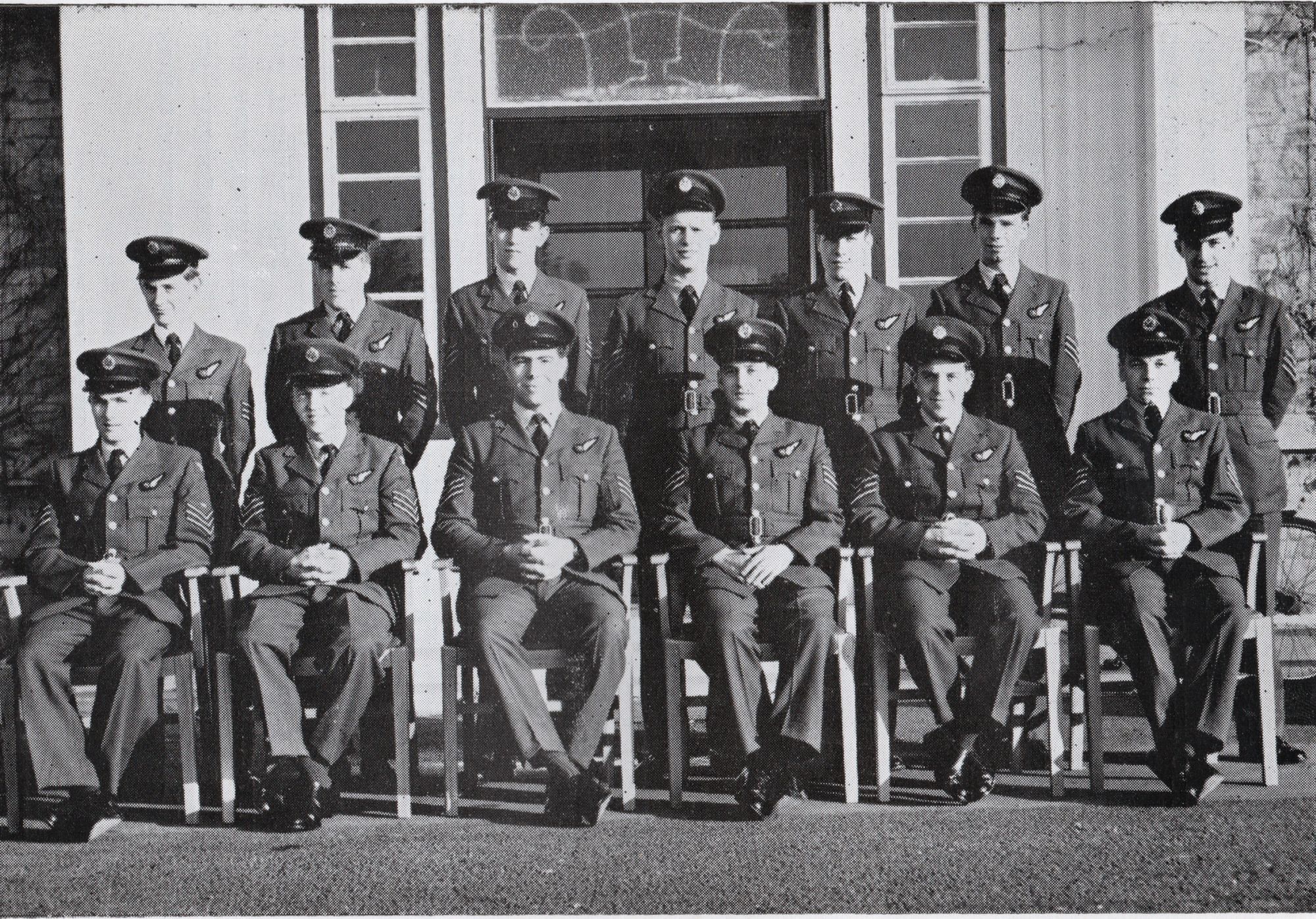
The photo above is of the final passing out group remaining from the 20 who started. Yours truly is rear row at the extreme left.
The ground school training covered a wide range of subjects such as Maths, Navigation, Electrical and Radio Fundamentals plus the ever present morse training. All Signallers had to be able to send and receive messages at 20 words a minute although I seem to remember that some of us got up to 22 words a minute. Failing to reach the required morse speed led to an individual being 'chopped' from the course and disappearing overnight. Similarly, failing any of the other subjects would also lead to suspension from training.
After about 6 months of Ground School we started on the Flying training part of the course. This comprised twenty flying exercises, of around 4 hours duration, which were each assessed , with a pass mark required at 60%. The aircraft we trained in was the Vickers Varsity, which was a multi purpose trainer aircraft also used in pilot and navigator training. It was a medium sized twin piston engined aircraft and very suitable for purpose. The crew for our flying exercises consisted of a pilot, navigator, electronics instructor and two students. These were unpressurised aircraft so we usually operated at up to 10000 feet, going above 11000 feet meant going on to oxygen although all night flying required use of oxygen from ground level upwards. Flying at these altitudes meant that you went through the weather rather than over it as most modern airliners do today. This meant it could be a bit bouncy with some risk of air sickness.
Most of the flying from Topcliffe was out over the Yorkshire coast at Whitby and then heading north, completing a rectangle flight path over the North Sea. To vary the routine we also had to do a certain amount of night flying, which meant a late take off in the UK summer months. This was largely to show up the differences in radio propagation and reception after nightfall compared to daylight hours. Towards the end of training we had an overseas deployment to RAF Wildenrath in West Germany. The purpose of this exercise was training in civil airways procedure and involved flying the airways routes across the UK, Belgium and Germany.
Total course length was 12 months with a couple of leave breaks and then we were awarded our flying badge, which in the case of Air Signallers was a half wing enclosing the letter 'S'. Our original numbers had been whittled down by about 30% as people failed various parts of the course. Most of those who dropped out were unable to reach the required ability in morse. It had little to do with a person's intelligence but was, rather, a lack of aptitude to assimilate the pattern of dots and dashes which made up the morse code.
Flying the training exercises was generally enjoyable with half of each exercise being performed with the electronics instructor on radio operating duties and the other time being spent with the navigator learning some of his skills and also with the pilot assisting with second pilot duties. Their was a certain level of stress as you had to pass each exercise with a minimum of 60% marks. However all in all the flying was satisfying and enjoyable. If you didn't enjoy it then you shouldn't have volunteered to fly !
Towards the end of flying training we were asked to nominate which Command we wished to join and most of us put down Transport Command ,which would involve flying the overseas airways routes to interesting places. On my course we all went to Coastal Command, which would involve flying in long range maritime patrol aircraft, primarily over the sea. The role of Coastal was a mix of anti submarine warfare, maritime reconnaissance and search and rescue missions. The aircraft used was the Avro Shackleton which was a derivative of the wartime Lancaster bomber. It was driven by 4 Rolls Royce Griffon piston engines and was a spectacularly noisy aircraft to fly in. Standard crew for the 'Shack' was 10 men comprising 2 pilots, 2 navigators, a flight engineer plus 5 electronics/ radio staff ( Air Signallers and Air Electronics Officers ). Typical missions could regularly extend to 10 or 12 hours, all flown at low level. If you were at all subject to air sickness then the Shackleton would find you out ! To the initiated they were often called 20,000 rivets flying in close formation.
All those newly posted to Coastal Command had to undertake a 6 months Operational Conversion Unit training before joining an operational squadron. Venue for this training was at RAF Kinloss on the Moray Firth in the north of Scotland. The training exercises were mainly flown at low level or, during a simulated submarine attack, at very low levels. The training for Signallers incorporated quite a lot of extra tasks up and above what had been taught in the flying at the Air Electronics school. We had to become radar operators, sonics operators, aerial photographers and visual observers. Training flights could vary between 4 and 8 hours, although an overseas deployment to Gibraltar, which each course had to perform, could take up to 12 hours.
On completion of the OCU then you would be posted to a Coastal Command airfield, which at that time was either Ballykelly in Northern Ireland, St Mawgan in Cornwall or remain with a squadron at Kinloss in the north of Scotland. Overseas postings available were at Gibraltar, Malta, Aden and Singapore.
Flying in a Shackleton was mainly not an enjoyable experience, being performed at low level over the sea in sometimes poor weather. They were something of a vomit comet ! Flying a night exercise, trying to home onto a very poor radar contact at low level with the smell of burnt cordite from the flare dispenser over your head whilst keeping down the contents of your stomach was definitely a character forming action!
Towards the end of the training at Kinloss it dawned on me that the remainder of my initial 9 year engagement with the RAF was likely to be doing this same routine for another 7 years. Did I really want to continue with this ? I was going to be 27 by the time of my release and I was not acquiring a transferrable skill. The other option after 9 years service was to sign on for 'life', which meant staying on in the RAF until the age of 40 with career progression to Flight Sergeant after 7 years and then to Master Signaller, which was equivalent to Warrant Officer 1st Class. I made it known that i did not wish to continue in the service and managed to gain my release after being kept on hold for about 6 weeks.
So here I was, 20 years old with no career plans. What to do next ?